Tuesday, October 31, 2006

Family Research Council Voter Scorecard


This post links to a Baptist Press article on the voter scorecard produced by Focus on the Family.

Amanda Banks, a spokeswoman for Focus on the Family Action, told Family News in Focus that the scorecard is one of the clearest explanations of voting records available to constituents. “They can use this, I think, in a variety of ways,” Banks said. “Of course, prior to the elections they can look and see how their members have been voting and use that information as they prepare to go to the polls.”

The PDF version of the scorecard can be downloaded here or here.

Wednesday, October 25, 2006

Dr. Mohler on the Secular view of Manliness

I found this article on Biblical Manhood v. Secular Manhood interesting. Click the title of this post to get there. There is also a link to the radio program Dr. Mohler did on this topic. You can listen online if you are so inclined.

Tuesday, October 24, 2006

King Pyro on Lordship-Salvation


Justin Taylor, of Between Two Worlds bloggage fame, has put together an indexed list of Phil Johnson’s series of articles on his personal experience with the “Lordship-Salvation” debate. Go to Taylor’s links and you can read the Pyromaniac’s posts in order.

After our discussion on how we don’t get the weight of our sin, I thought this would be good reading. I am still reading through them myself. I think this issue is where the rubber meets the road in our race to the Throne. If we can’t live under the Lordship of Christ, there’s some serious questioning that needs to take place about the status of our faith. Again, none of us will be perfect this side of Heaven, but if we are not growing in the fruits of the spirit, we need to take a hard look at the status of the tree.

Tuesday, October 17, 2006

ESV - Truth Bible Memory Verse

This week’s ESV Bible Memory Verse is on the Return of Christ:

For this we declare to you by a word from the Lord, that we who are alive, who are left until the coming of the Lord, will not precede those who have fallen asleep. For the Lord himself will descend from heaven with a cry of command, with the voice of an archangel, and with the sound of the trumpet of God. And the dead in Christ will rise first. Then we who are alive, who are left, will be caught up together with them in the clouds to meet the Lord in the air, and so we will always be with the Lord. Therefore encourage one another with these words. 1 Thessalonians 4:15-18

Monday, October 16, 2006

Job's Sin, God's grace, with additional thoughts...


This week we discussed Job’s response to God’s monologue in chapters 38-41. But first, we began the class with a hypothetical I read earlier this month.

What About Bob?

There’s a guy, let’s call him Bob. He’s a nice guy. He has a sweet family. He has a good job. He works very hard. He obeys the traffic laws. He pays his taxes. He goes to church. An offering plate never passes by that he doesn’t put something in it. Is he a good guy? Sure.

Oh, there’s one other thing: when he gets the urge, Bob likes to molest little children. Or, Bob likes to blow up Federal buildings and commit mass murder. Pick your one heinous crime. Is Bob still a good guy?

Of course not. With that one piece of information, all of the “good” things Bob does are nullified by that one horrible act. In fact, many of you are thinking, “There’s a lot of undeveloped land in East Texas where we could hide the body of a guy like that.”

But, what about all this other good stuff Bob does? Well, I think it is safe to assert that we value children more than traffic laws, don’t we? Or the lives of everyday people over Bob putting something in the offering plate.

The Greatest Commandment

So why do we, Christian or non-Christian, so regularly commit an even worse error in our evaluation of what is good and evil? What is the greatest moral responsibility? (Mark 12:28-31). We are appalled at the horrible crimes of Bob, but why don’t we realize that if we don’t love God with everything within us, we have committed the worst crime of all. We usually judge the rightness or wrongness of an act based on our opinion. It is an extremely rare occasion when we judge the rightness or wrongness of a matter by its offensiveness to God.

Sin Unplugged

How do we define sin? I’ve tended to define it as selfishness, but is that a proper definition? In his very readable and well-written Systematic Theology, Wayne Grudem points out that (1) the Bible does not define sin this way, (2) much self-interest is good and approved by Scripture (for example, when Jesus exhorts us to “lay up for yourself treasures in Heaven” or God’s appeal to the sinful, “Turn back, turn back from your evil ways; for why will you die, O house of Israel?” (Ez. 33:11) (3) What about selfless devotion to a false religion? (a Muslim suicide bomber is doing a selfless act, right?) (4) What about God, since God’s highest goal is to seek His own glory (Isa. 42:8; 43:7, 21; Eph 1:12) ?

Grudem defines sin as any failure to conform to the moral law of God in act, attitude or nature. I have also heard John Piper define sin as “Trading the glory of God for other things.”

Scripture certainly defines sin in relation to God and His moral law. (1 John 3:4; Rom 2:15, 17-29) All people sin due to their lack of conformity to the moral law of God.

Well, what is the moral law? Exodus 20 – the Ten Commandments. Have you examined your life in light of these ten simple commands? Where do you stand? Have you examined your life in light of Jesus’ illumination of the commandments in Matthew 5? He says the commandments go beyond the external actions, but also focus on the internal attitudes. We further see in James 2:8-11, that to violate one commandment is to violate all of the commandments. That’s a pretty hard pill to swallow. How can violation of just one commandment be the same as violation of all?

James tells us that it is because of Who we are offending by our breaking of the law. The law is not just a piece of divine legislation, it is a revelation of the very infinitely worthy character of God Himself. Any violation is an affront to Him, and He takes it personally, as well He should.

Job, Isaiah and the state of being “undone”

What in the world does all of this have to do with Job? We have seen that Job’s suffering had two purposes. At the beginning it was to demonstrate God’s value and glory. But later, God permitted the suffering of Job to continue in order to fulfill the ongoing purpose of refining Job’s righteousness.

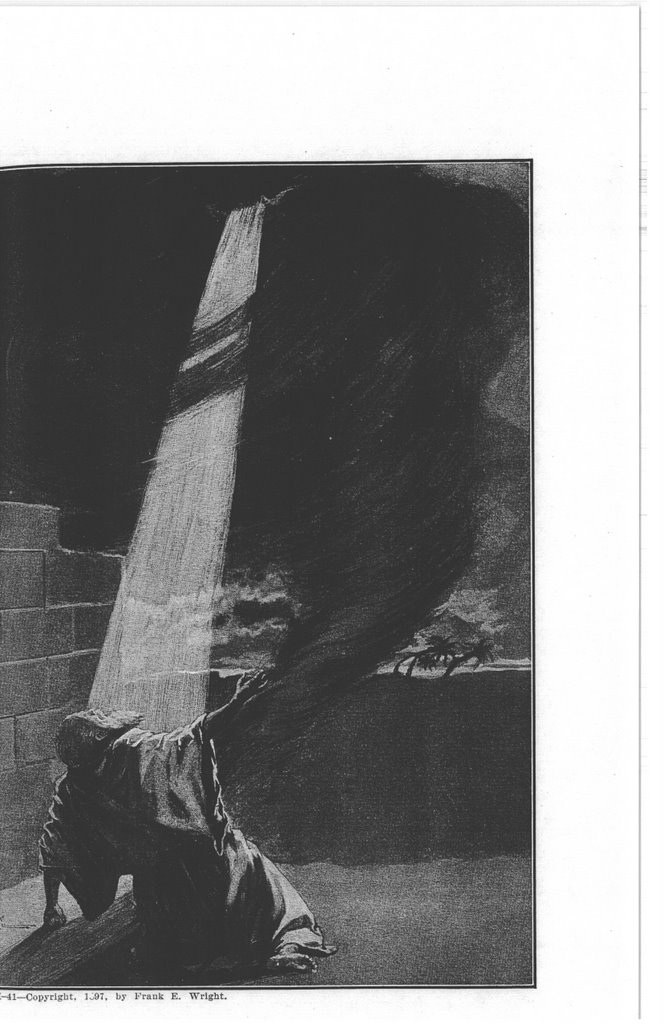
A thunderstorm gathers at the end of Elihu’s speech. Somehow, out of the whirlwind, the voice of God speaks to Job. It’s a pretty ominous beginning.
“Who is this that darkens counsel by words without knowledge?”
We know that God is talking about Job, because Job knows God is talking about Job…(42:3, Job quotes the question and answers it by stating that he is putting his hand over his mouth.) God interrogates Job with questions that show God’s infinite greatness compared to Job’s finite and flawed understanding of the reality of things. God focuses on things above the earth, on the earth and under the earth. The point is that Job is ignorant and helpless. He doesn’t know where these things come from, how to make them work, and is utterly surrounded by mysteries.

“Behold, I am Vile.”

At Chapter 40, God gives Job a breather to respond, and we see that Job is starting to get it. What is his response in the face of the infinite and holy God? “Behold, I am vile.”

This is one of the few times that I prefer the KJV rendition. The Hebrew word “Qalal” can mean “of small account” or “insignificant” or other similar expressions. However, I think “vile” captures the contrast between the previous attempts of Job to justify himself and his attitude when faced with the holiness of God. This is also consistent with other accounts of saints being in the presence of God. See Isaiah 6.

Faced with God’s majesty, Job is surprised at his own sin: “Behold!”

It’s the word, “behold” that tips us off to Job’s astonishment at his own sin and finitude. The discovery was unexpected. He’s spent the entire book extolling his own righteousness and the great case he was going to make to God about how he has been mistreated. But, in the presence of a holy and all-powerful God, the realities come crashing in on him. Consider this quote by Charles Spurgeon.


“I believe we generally find out most of our failings when we have the greatest access to God. Job never had such a discovery of God as he had at this time. God spoke to him in the whirlwind, and then Job said, ‘I am vile.’”

We don’t get our sin

Doesn’t this show us how much we just don’t get the vileness of our own sin? Christian and unbeliever alike. Both the Christian and non-Christian have this in common: there is a nature that is in rebellion to God. The difference is that the true Christian realizes it because of the eye-opening power of the Holy Spirit and is compelled to make war against it out of a God-given desire to want to be pleasing to God by reflecting as much of His character in his life as he is able. (Of course, I use the masculine pronoun for the Christian in a non-gender specific way, ladies)

Sin, it’s so natural

It is important to realize that there are acts that people who have not trusted Christ do which we would consider good in relation to those around us. There are actually Muslims who do not murder. There are Buddhists who do acts of benevolence such as feed the poor. A group of atheists can pull together and repair houses after a hurricane. But, Scripture tells us that whatever is not from faith is sin. (Romans 14:23) The issue is - what moral and spiritual character does that act have in relation to God?

John Piper posits the analogy that if a king teaches his subjects to fight well and those subjects rebel against their king using the very skill he taught them to resist him, then even those skills are evil. Since all people are in total rebellion, everything they do is the product of the rebellion and cannot glorify God. It only further condemns them for their rebellion. With such darkened minds and corrupt hearts, how could we ever change? Consider the testimony of Scripture.


For the mind that is set on the flesh is hostile to God, for it does not submit to God’s law; indeed, it cannot. Those who are in the flesh cannot please God. (Ro 8:7-8)

Now this I say and testify in the Lord, that you must no longer walk as the Gentiles do, in the futility of their minds. They are darkened in their understanding, alienated from the life of God because of the ignorance that is in them, due to their hardness of heart. They have become callous and have given themselves up to sensuality, greedy to practice every kind of impurity. (Eph 4:17-19)
(God lets us freely do what we most love to do).

To the pure, all things are pure, but to the defiled and unbelieving, nothing is pure; but both their minds and their consciences are defiled. (Tit 1:15)

The natural person does not accept the things of the Spirit of God, for they are folly to him, and he is not able to understand them because they are spiritually discerned. (1 Co 2:14)
What kind of freedom of choice does Scripture say the unbelievers whom you know actually have? Apart from the work of the Holy Spirit, does Scripture say whether or not they will change their fundamental rebellion against God?

Self-mutilation for the Kingdom of God? (The call of Christ to gouge the eyes and cut off hands)

As believers, we know that through the power of the Holy Spirit we have been born again. The nature that once reigned over us has been stripped of its dominion. We are no longer slaves to sin. However, we still sin. As Christians, we are given some stern warnings about our own sin. 1 Cor 6:9-10; Gal. 5:19-21. Consider the warnings of Jesus concerning how radical we are to deal with sin in our lives.
If your right eye causes you to sin, tear it out and throw it away. For it is better that you lose one of your members than that your whole body be thrown into hell. And if your right hand causes you to sin, cut it off and throw it away. For it is better that you lose one of your members than that your whole body go into hell. (Mt 5:29-30) (see also Mark 9:43)
Of course, He also says that sin comes from the heart, so it is clear that He does not mean literally cut off your hand or gouge your eye. But, who talks like this? Jesus talks like this. Those who see the vileness of sin talk like this. The vast majority of us do not talk like this. We don’t take our sin seriously. If this does not seem obvious to you – that sanctification is worth any pain on this earth – it is probably because you don’t abhor sin and prize holiness the way God does and the way we all should.

As believers, we are to make war against our sin nature. This sin that so easily besets us is a traitor to us. We are to be radical in our hate of the nature that rebels against the God Who has given us so much grace.

We will not be perfect as Christ is perfect this side of eternity. Romans 7:13-25. Sanctification is a life-long process. But, as you look back over the last few years of your Christian life, can you see a pattern of definite growth in the fruits of the Spirit? Are you more righteous today than you were a few years ago? If we are not, we should test ourselves to see if our faith is genuine.
Philippians 2:12-13; 3:12-16; 2 Cor. 13:5

God acted with purpose, not arbitrarily, in sanctifying Job. He acts with purpose in sanctifying us.

Job’s response should be ours

We see three acts of submission by Job on chapter 42:1-6

v. 1-2 – He submits to God’s absolute sovereignty: that He can do whatever He pleases, and is not constrained by anything outside of Himself.

v. 3 – He quotes God and then gives his response. He submits to God’s infinitely greater wisdom and knowledge: Job recognizes that he has spoken about things of which he is very ignorant.

v. 4-6 – He again quotes God and gives his response. He repents.

Getting a realistic picture of our sin and God’s holiness only serves to magnify His grace towards us. It also magnifies our great dependence upon Him for the very ability to not sin.

“Grant us the will to do as You command. Then command us to do as You will,” Saint Augustine prayed.

I can’t remember where this quote came from, but I remember it was from an old saint on his deathbed. I think he was asked what he had learned in the many years he had lived as a Christian. His response was classic, “I have learned that I am a great sinner, and that I have a Great Savior.”

Let us remember that the writer of Hebrews admonishes us, “Let us consider how to stir up one another to love and good works…” (Heb. 10:24-25)

Wednesday, October 04, 2006

Bible Reading Plan


There are probably as many Daily Bible Reading plans as there are those with a Bible and a calendar. However, I found an interesting one you may find helpful to keep you motivated in reading your Bible consistently.

Each day of the week, you read anywhere from one to six chapters out of a different part of the Bible. Each week, you cover one or more chapters out of each major area of the Bible: The Law, History, Psalms, Poetry, Prophecy, Gospels, and Epistles. But, by switching areas daily, the thought is you don't get bogged down several days or weeks on an area that I might not currently find as interesting.

Some people lose it at Leviticus. I don't get that personally...but some do. Here's a way to keep moving and sample different types of Biblical literature each day. There's also a nifty little one-page chart you can print out and check off each day as you progress.

Wednesday, September 27, 2006

Blessed Assurance

Every week the ESV website puts out a memory verse through one of their RSS feeds. (See yesterday's post) This week is on Assurance and the verse is John 10:27-28 in which Jesus promises:

My sheep hear my voice, and I know them, and they follow me. I give them eternal life, and they will never perish, and no one will snatch them out of my hand.


What confidence we can have in the hands of the Savior!

Tuesday, September 26, 2006

Geek info

I have stumbled upon something I am sure many of you already know about...site feed readers. These are programs that pull all the blogs, news sites, etc., that you normally have to go from page to page on your browser into one place (soooo tedious...). The program lets you know when the site is updated and you can check it out right then rather than wait for email notification.

Here's the link. It's free. It downloaded pretty fast and with little effort on my part. To add this blog, just copy the web address and paste it into the window after you click "New". Hit OK and it should find the site feed address on its own. You can pick the "RSS" or "Atom" feed, it really doesn't matter.

Just another tip from your friendly neighborhood tech geek. God bless and hopefully see you Wednesday. The Men's Ministry lesson this week is on "Broken Relationships" and is being taught by Scott Ritchison. After reading the chapter in the book, we should have a good discussion on priorities.

Tuesday, September 19, 2006

Some thoughts from last week's lesson...

Although there were several good points from the lesson last week on Job's Testimony, one point Scott made has stuck with me the most. I have written in my notes, "1) Temptation to give up on God."

Tonight, I was updating the prayer list and saw so many circumstances that just break my heart. I think of the situation with Mimi (not Youngblood) and the loss of that baby after carrying her nine weeks. I think of Troy's family and the loss of a father and a husband and the sense of abandonment with which they must be wrestling. I think of little Noah facing heart surgery at seven years old. I am reminded of the ongoing struggle with the health of Jill's dad. Then also, my heart goes out to Robyn and Christi and the inner struggles they must be going through having mothers with cancer. I am sure there are many others unspoken or outside of our class for which we have no clue.

What is the temptation for each of these? The temptation is to assault God with the accusation of being unfair and unjust. This is where the rubber meets the road, so to speak. Do we trust the testimony of Scripture that God is absolutely sovereign and absolutely good when our hearts are pulling apart, when we are fatigued of facing the pain and the problem day after day?

"Why did You let this happen?"

"How could a loving God allow such things to go on?"

"Don't You care?"

"Am I on my own with this?"

"What's the use of being a Christian if You won't or can't protect me from this pain and suffering?"

And the questions go on and on...As Scott said, Scripture shows us that our Father welcomes honest questions. We should take our concerns to God directly. Through Christ, Hebrews tells us that we can boldly (ESV says "confidently") come to the throne of grace. I heard an old pastor say once that we enter boldly, but not brazenly. There is a difference in an honest question and a disrespectful accusation.

I must confess up front that my own times of testing have shown me that I have so much to learn about relying on the Lord and being confident in His goodness and power to work all things together for the good. I am praying for those who are in these circumstances to be much wiser about recognizing their need for Him to sustain them than I was.

Nevertheless, I throw this out for your comment. What have you learned from Job to help deal with these types of situations? What have you learned about God so that you are equipped to overcome the temptation that is so prominent in a crisis? If you are in a crisis circumstance, where is Christ in the middle of it?

This blog is meant to be an interractive tool for us to discuss what we are studying throughout the week. Use the comment button at the bottom of this post to respond. With so many Job-like situations present just in our class, how does the study of God's sovereignty in the suffering of the righteous effect your hearts in these trials? Does the study of Job cause you to handle these things differently than you would have otherwise?

Wednesday, September 13, 2006

Does God Want Us to Be Rich? TIME Looks at Prosperity Theology


Time Magazine, of all things, has taken on the prosperity theology so prevalent in the Western Church today. This article is timely with our study of Job. Take a look at Al Mohler's comment on Time's coverage of "preachers" like Osteen, Jakes, etc.

There is the issue of priorities. For what do we as a church strive? Do we strive for the theater seats for the main service to comfortably watch the show? Or would we be content with those hard fold-out metal chairs as long as the Lord's Table is spread before us and we can feast on the pure Word of God? Do we seek numbers? Or do we seek fellowship with and the making of true brothers and sisters in Christ who are growing in grace and who bear the marks of true faith: Love for Christ and a love for all the saints? Do we seek position: to be known by others as the "best church in Tyler"? Or do we seek the servants' faithfulness to His Word that oftentimes goes unnoticed by the masses?

When I read about these kinds of situations in the Church, it is tempting for me to feel that my church is much more holy and more Christian than the mega-churches. But, if we really examine our own hearts, even though we may profess to not believe in the doctrines of personal prosperity and pragmatic church growth, I wonder if our actions sometimes betray differently. Do we truly trust Christ alone for the health and growth of this body we call Calvary? Or do we sometimes try to take that growth into our own hands forgetting that it is Christ Who will build His church?

He builds His church when He grants us faithful hearts to His Word. He builds it when He grants us sincere love for one another. He builds it when He grants us those precious opportunities to share the gospel of His grace with the lost. He builds it in a thousand thousands of other ways that we do not even see. He builds it when He grants us the wisdom to use our finances in ways that exhibit our Christ-centeredness rather than to build for ourselves a name. Some gifts are shortly realized. Others have been in the works for years. His gifts to us, for His glory and our good.

Tuesday, September 12, 2006

Help needed for Mother of three

I got a call from Fred earlier today. There is a young mother of three in our church who has had her transmission go out on her car. It has been a tough time for her and she needs some help. Fred asked if I knew of anyone with an extra car she could borrow while her transmission was getting fixed. If you have an extra car to loan that would accommodate three children, please contact Fred or Mary at 903-939-3200.

"By this all people will know that you are my disciples, if you have love for one another." (John 13:35)

Sunday, September 10, 2006

What on earth is a Daysman?

In class Sunday, we were studying Job's recognition of his need for an "umpire" between him and God. In looking at the KJV of the passage, the word "daysman" is used instead of mediator, or arbiter, or someother similar phrase. Scott asked me if I knew what a "daysman" was, and, although I was confident it was another word for mediator, I had to admit I was unfamiliar with the origin of the word. As you can imagine, it was a difficult time for me. I have yet to recover from my shame. Nevertheless, I looked into it when I got home that afternoon. Here is what I found.

Consider the different translations of Job 9:33, part of our text in Sunday school last week.

Neither is there any daysman betwixt us, that might lay his hand upon us both. (KJV)
If only there were someone to arbitrate between us, to lay his hand upon us both, (NIV)
There is no umpire between us, Who may lay his hand upon us both. (NASB)
There is no (or would that there were an) arbiter between us, who might lay his hand on us both. (ESV)
There is no one to judge between us, to lay his hand on both of us. (HCSB)
Daysman is an old English word formed from the Latin diem dicere, i.e., to fix a day for hearing a cause. Diem means "day" (we talk of per diem reimbursements). Dicere means "to judge". A Daysman is empowered by mutual consent to decide the cause, and to "lay his hand", i.e., to impose his authority, on both parties, and enforce his sentence. We use the term arbiter today.

It is important to understand that in the Greek of the New Testament there two major terms for "time." One, chronos, emphasizes the passage of time without any stress on the significance of events in the period; the other, kairos, stresses the special or revelatory significance of time. All life happens between chronos and kairos, so to speak. Or, to put it differently, chronos is one thing after another; kairos is one significant event.

Our word "day" is a word that captures in its various definitions both of the biblical meanings of time. On the one hand is the "chronological" meaning of "day"-- "the time of sunlight," as it is defined in the dictionary. On the other hand we know that "day" can signify a "great day" or an important day. The theological concept of the Judgment Day or "the Day of the Lord", stresses this meaning.

Pushing the research further, "Day" had a rich significance in law that has been lost to our day, and this usage relates to day as a verb. "To day" means "To appoint a day to anyone" or "to cite or summon for an appointed day," such as in the 15th century sentence, "he should be sente fore and dayed ernestly agayn, for to abyde such jugement."

But the second usage of "day" as a verb is "to submit (a matter) to, or decide by, arbitration." We know that the use of "day" in this manner was already obsolete in the 18th century, but an Oxford English Dictionary example from the 16th century is "They have him enforced when all their money was...spent, to have their matter dayed, and ended by arbitrement."

This use of "day" seems to have spawned two nouns, "dayment" and "daysman." "Dayment" is simply defined as "arbitration," such as in the sentence "to spende all..that money and put it to dayment at last." A "daysman" is an "umpire or arbitrator; a mediator" in its archaic usage, according to the OED. From a 16th century legal source we have, "If neighbors were at variance, they ran not straight to law: Daysmen took up the matter, and cost them not a straw." Or, in another case, "They had some common arbitrators, or dayesmen, in every towne, that made a friendly composition between man and man."

The sense from the quotation just given is that arbitration, or dayment, was not only a cheaper procedure than a court trial, but was the principal method to reconcile parties and deliver quicker justice than might be attainable through the King's Bench or Common Pleas or Exchequer. In his magisterial history of English law in the 16th century, Baker points to the popularity of arbitration at any stage of the legal proceedings in this period, even though the surviving records of arbitrations are much more scanty than purely judicial proceedings (Oxford History of the Laws of England, 333-34). Thus daysmen were important in that period, even though the word has long disappeared from our vocabulary.

Yet even though the word is no longer used, its 16th-17th century usage is preserved in a most unlikely place: the Book of Job in the King James translation of the Bible (1611). When Job is expressing his frustration with not being able to know how to approach God in his distress, he expresses a contrary to fact wish (Job 9:33) which the KJV translated as follows: "Neither is there any daysman betwixt us, that might lay his hand upon us both." It is interesting that the KJV translators were following the 1535 English translation of the Bible by Miles Coverdale, who rendered 9:33 as follows: "Nether is there eny dayes man to reprove both the partes, or to laye his honde betwixte us."

A leading commentator on the Book of Job, David Clines, comments on this passage that the author isn't specific as to whether what is in view is a person who has the power to make decisions or just to try to reconcile the parties (Job 1-20, p. 243). He actually translates the Hebrew word (Mochia) as "mediator," which seems to be precisely wrong. What is in view in Job 9:33-34 is an umpire-like figure who can "lay his hand upon us both."

The phrase "lay his hand" only appears in the Hebrew Bible in one other place, Ps. 139 (verse 5). In that context the words "lay his hand upon" suggests the authority of God to make something happen in the Psalmist's life. In law the person who can make decisions by "laying his hand" on both parties is the arbitrator, not the mediator.

A mediator in American law is a person who can get parties together and make suggestions (and even some warnings/threats), but s/he has no authority to force a decision on the parties. Thus, I think the KJV has it right after all--what Job is longing for is not simply a mediator, but an arbitrator, a daysman with all his power. Further, Job might consider a human judge as capable of acting as an umpire upon his own claims, but no man was worthy to question the purposes of Yahweh, or metaphorically, to "lay his hands upon" Him. To that end, I think the English Standard Version is the most correct in that it uses the term "arbiter", which is consistent with the context, rather than "mediator."

Commentator Arthur Walwyn Evans, notes that in the New Testament (1 Corinthians 4:3, anthropine, hemera) "man's judgment" is literally, "man's day," in the sense of a day fixed for the trial of a case. Both Tyndale and Coverdale so translate. See also 1 Timothy 2:5, where the Saviour is termed the "one mediator .... between God and men." Here the word connotes a pleader, an advocate or lawyer before an umpire, rather than the adjudicator himself (see Job 19:25-27).

Saturday, September 09, 2006

Nathaniel update...


Yes, we are home...Thank, God. Thanks for all your prayers, visits and calls. Tammy is doing well, but still recovering. Nathaniel is also doing well, but learning the fine art of sleeping...I am committed to his advanced studies on that topic.

We've got pictures, if you're interested. Here and here.

Remember, tonight is the "Reconnect" social over at the Rose's. More details in the sidebar and Scott's letter here. Hope to see you there.

Thursday, September 07, 2006

Thirst is a Liar

Did you know that thirst is a liar? You can't always trust your sense of thirst to keep your water intake above the minimum required for good health. An hour of hard work or athletic competition that involves heavy sweating, for example, can dehydrate the body far beyond what a person would ordinarily feel like drinking. Similarly, people who are sick or elderly often have a dulled sense of thirst. In instances like these, it's better to trust objective guidelines than your own feeling of satiety.

In the same way, we don't drink long enough or deep enough from the Word of God on a regular basis. If we trust our "felt need" for Scripture, we would be spiritually dehydrated, indeed. Many times when we are spiritually "sick" through unrepentant sin, for example, or some lengthy trial, we don't even realize our desparate need for the Word of God to nourish our souls. I have found that an objective reading schedule is very helpful. There is no right schedule. Just pick something that is consistent and gets you deeper into study than the casual reading of the newspaper.

Here's one I like for a good overview:

Old Testament


  1. Genesis (History of Creation, Fall, and Covenant in Patriarchal History)

  2. Exodus (History of Israel’s liberation and formation as people of God)

  3. Joshua (History of military conquest of promised land)

  4. Judges (History of transition from tribal federation to monarch)

  5. 1 & 2 Samuel (History of emerging monarchy with Samuel, Saul, and David; the golden age of Israel)

  6. 1 & 2 Kings (History of Solomon and the division of the kingdom; the fall of Israel and the beginning of the age of the prophets)

  7. Ezra/Nehemiah (History of return from exile; restoration of Jerusalem)

  8. Amos and Hosea (Examples of Minor Prophets)

  9. Jeremiah (Example of Major Prophets)

  10. Ecclesiastes and Song of Solomon (Examples of Wisdom Literature)

  11. Psalms and Proverbs (Examples of Hebrew poetry)


This gives an Old Testament overview to which you can fill in the gaps later on.

New Testament

  1. Luke (Life and teaching of Jesus)

  2. Acts (History of early church)

  3. Ephesians (Introduction to teaching of Paul)

  4. 1 Corinthians (Teaching in the life of the Church)

  5. 1 Peter (Introduction to Peter)

  6. 1 Timothy (Introduction to Pastoral Epistles)

  7. Hebrews (Theology of Christ)

  8. Romans (Paul’s theology)


After this is finished, go back and fill in the gaps. This gives an overview of the component parts of the New Testament.

I read an article once where a teacher suggested starting in three different places: Genesis, Job, and Matthew. Apparently, that's almost the Bible in thirds. The idea is that it breaks up the reading so that you get several types at once. I’ve also heard that 3 chapters on the weekdays and 5 chapters each on Saturday and Sunday will get you through the Bible in a year. That would certainly get us through the New Testament several times a year. However, that pace is not the best for "study". But after reading the Bible through a few times, you'd be amazed at how you remember other passages and statements that shed light on what you are currently reading. I guess the point is: start somewhere and read it systematically.

I've also included 10 Rules for interpreting Scripture, just in case you find that helpful.

    Rule 1: Read it like any other book. In other words, read poetry like poetry, narratives like narratives, and doctrinal treatises (i.e., Romans) like, well, doctrinal treatises.

    Rule 2: Get under the skin of the characters. Get into the context of why the book was written and under what circumstances.

    Rule 3: Historical narratives are to be interpreted by passages that teach or explain. Don't look to the life of David as a complete pattern for living. Look to the books that teach those principles. It may be that a story of David's life was included to show what not to do, for example.

    Rule 4: What is implied should be interpreted by what is expressly stated.

    Rule 5: Determine carefully the meaning of words

    Rule 6: Note the Presence of Parallelisms in the Bible

    Rule 7: Don’t make a Proverb into a Law…and vice versa

    Rule 8: Note the difference between the Spirit and the Letter of the Law

    Rule 9: Be Careful with Parables

    Rule 10: Be Careful with Prophecy
Please note that we shouldn't ignore parables or prophecy and just accept what those with credentials would tell us. Study parables and prophecy, but study them carefully in light of the rest of Scripture. Scripture interprets Scripture.

Job - With Friends Like These...

Two Sundays ago, Scott taught on what we learn NOT to do from Job's three friends.

Job's three friends, Eliphaz, Bildad, and Zophar teach us:

I. THE WRONG WAY TO HELP A FRIEND WHO IS HURTING

1. Don't make FALSE assumptions about why (they're hurting)
2. Don't make FAULTY conclusions about God's will

II. THE RIGHT WAY TO HELP A FRIEND WHO IS HURTING

1. BE THERE for them
2. CRY with them
3. LISTEN more TALK less
4. ATTEND to their physical needs
5. PRAY with them

III. HOW YOU SHOULD RESPOND WHEN FRIENDS FAIL YOU

1. Don't DENY your disappointment
2. Don't let them make you BITTER – Job 12: 2-3
3. PRAY for them – Job 42:10